
How does Flex provide outsourced manufacturing and high-value engineering to OEMs while capturing services revenue?
Flex absorbs manufacturing complexity and capex risk for OEMs, earning through engineering, supply-chain services, and service contracts. In fiscal 2025 Flex shifted to higher-margin solutions like power management and circular-economy services, supported by rising ASPs and services revenue.
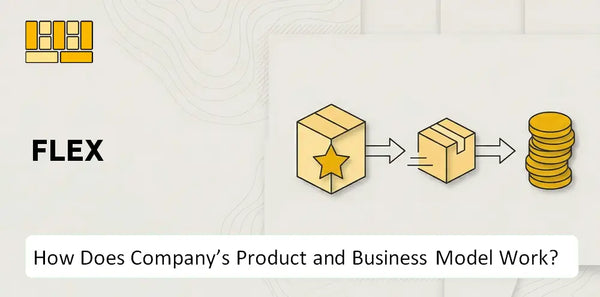
Flex converts scale into recurring services and design wins, shortening customer time-to-market and improving retention; see its Flex Business Model Canvas for the product-to-revenue map.
WWhat Does Flex Offer Customers?
Flex sells end-to-end product lifecycle services and high-volume manufacturing for electronics and complex mechanical systems, combining engineering-led Sketch-to-Scale design with rapid-scale contract manufacturing to reduce time-to-market and unit cost for customers.
 Core Product Lifecycle and Manufacturing Services
Flex company product centers on two segments: Reliability Solutions (engineered systems and long-life products) and Agility Solutions (fast-turn, high-volume manufacturing). It is best known for integrating design, supply chain management, and manufacturing to deliver finished electronic and electromechanical products.
Primary Customers and Users
OEMs in automotive, healthcare, industrial, cloud data centers, communications, and consumer electronics rely on Flex for contract manufacturing and engineering partnerships. Tier – 1 suppliers and startups use its Sketch-to-Scale service to turnkey products from prototype to mass production.
Value Delivered to Customers
Customers gain faster product launches, lower per-unit costs, and optimized manufacturability through co-developed IP and supply chain orchestration. Flex also offers advanced power distribution and thermal solutions tailored for AI-driven data centers, improving energy efficiency in high – compute environments.
Commercial Importance in the Market
Flex business model addresses demand for scalable, resilient electronics manufacturing and supply chain management; its dual focus on reliability and agility lets clients shift between long-life programs and on – demand manufacturing. As of fiscal 2025, Flex reported diversified revenue streams with significant growth in cloud and automotive programs, reflecting industry trends toward electrification and AI infrastructure.
The company's offer includes: specialized engineering for autonomous driving systems, medical devices, and renewable energy infrastructure in Reliability Solutions; rapid-scale manufacturing for cloud data centers, communications hardware, and consumer devices in Agility Solutions; and Sketch-to-Scale co – development where Flex engineers optimize designs for manufacturability and cost. See Customer Acquisition of Flex Company for related customer strategy detail.
Flex SWOT Analysis
- Complete SWOT Breakdown
- Fully Customizable
- Editable in Excel & Word
- Professional Formatting
- Investor-Ready Format

HHow Does Flex's Product or Service Reach Users?
Flex Company delivers products through a global network of manufacturing and services sites, producing close to end markets and integrating digitally with customers for real-time visibility and rapid scale-up. Orders flow from customer design/integration into regional plants, then through managed logistics to final assembly or distribution hubs.

Regionalized operating flow
Flex runs over 100 manufacturing and services sites across ~30 countries, using in-region for-region production so units move fewer miles and face lower tariffs and lead times.
Product and service delivery process
Customers connect via B2B contracts and APIs; Flex's digital supply chain platforms provide real-time order tracking, build status, and ETAs while logistics teams handle customs, local compliance, and final-mile delivery.
Production, sourcing, and development
Engineering-to-manufacturing handoff uses a digital thread that shortens new-product onboarding to weeks; sourcing leverages regional supplier networks to lower component lead times and reduce geopolitical risk.
Channels and distribution
Distribution is primarily direct B2B to OEMs, hyperscalers, and Tier-1 suppliers via long-term contracts, complemented by logistics partners for freight consolidation and local distribution centers.
Key assets and partnerships
Core assets include regional factories, proprietary digital supply-chain platforms, and supplier relationships; strategic partnerships with logistics and component suppliers enable on-demand scaling and quality control.
What keeps it running day to day
Operational uptime depends on synchronized planning and real-time data: production schedules, vendor-managed inventory, and the digital thread that tracks margins, yields, and delivery times across sites.
For a company overview and history of how Flex evolved this model, see Brand Story of Flex Company
Flex VRIO Analysis
- Complete VRIO Analysis
- No Research Needed – Save Hours of Work
- Built by Experts, Trusted by Consultants
- Instant Download, Ready to Use
- 100% Editable, Fully Customizable

HHow Does Flex Earn Money from Usage?
Revenue flows from customer orders through manufacturing and design services into recurring post-sale streams; demand converts into invoices via assembly contracts, JDM fixed-price projects, and lifecycle services that capture margins after shipment.
Manufacturing and Design Contracts Drive Core Revenue
Manufacturing service agreements and Joint Design and Manufacturing (JDM) projects are the primary source of revenue because they combine recurring assembly volumes with higher-margin design work, anchoring customer relationships and long-term orders.
Post-Manufacturing and Reliability Services
Secondary income comes from component sourcing markups, warranty repairs, recycling programs, and Reliability Solutions services, which boost lifetime value and margin capture across the product lifecycle.
Pricing and Monetization Logic
Flex uses cost-plus pricing for high-volume assembly and fixed-price contracts for JDM. Contracts often include volume tiers, engineering fees, and pass-through component costs with negotiated markups to preserve margin.
Reliability Solutions: The Strongest Revenue Driver
Reliability Solutions, with operating margins typically between 5.3% and 6.0%, is the clearest margin driver versus the lower-margin Agility segment; management targets overall fiscal 2025-2026 revenue of roughly $25 billion to $28 billion after the solar tracker spin-off.
For context on ownership and historical strategy shifts that shape these revenue choices see Leadership and Ownership of Flex Company.
Flex Marketing Mix
- Complete Marketing Mix Analysis
- Effortlessly Communicate Your Business Strategy
- Investor-Ready Format
- 100% Editable and Customizable
- Clear and Structured Layout

WWhat Makes Customers Stay with Flex's Model?
Flex Company's model is sustainable because deep technical integration and regulated-industry lock-in raise switching costs, but it is fragile to major IP loss, raw-material shocks, or regulatory shifts that alter certification pathways. Strengths include proprietary modules and ESG services; dependencies include customer certification cycles and specialized supply chains; risks center on geopolitical sourcing and commoditization of key components.

Why Customers Stay: Structural Locks and Operational Dependence
Customers remain because changing suppliers is costly and risky, and Flex embeds itself into design, validation, and compliance processes. Ongoing investments in IP, vertical capabilities, and sustainability reporting deepen that dependence.
- Exceptionally high switching costs from multi-year programs in regulated industries like healthcare and automotive
- Dependency on lengthy re-validation, re-certification, and re-tooling timelines that deter switching
- Proprietary power modules and advanced cooling IP create technical lock-in for AI and high-performance electronics
- Model appears resilient due to systemic integration, but exposed if core IP is compromised or global regulations shift rapidly
Customer retention drivers - in detail:
- Regulatory lock-in: For regulated clients, switching entails re-certifying facilities and parts; typical automotive/medical revalidation programs run 12-36 months and can cost $5-50M per major program, making replacement prohibitive.
- Program-level commitments: Flex often wins multi-year, program-level contracts covering design, validation, and manufacturing; program economics create sunk costs for customers.
- Vertical integration: Investments in proprietary modules (power, cooling) and in-house advanced assembly reduce lead times and improve performance; customers rely on these unique components to meet product SLAs.
- ESG and compliance services: By 2026, Flex's managed sustainability reporting and supplier due diligence became a primary loyalty driver, helping clients meet carbon border adjustment mechanisms and labor compliance across >50 countries.
- Supply chain orchestration: Flex's global footprint and supplier relationships lower procurement friction; centralized quality-control processes maintain traceability required by regulated industries.
- Risk amortization: Customers spread certification and validation risk across program lifecycles, favoring a stable partner rather than re-qualifying multiple vendors.
- Technical support and IP co-development: Long-term R&D partnerships embed Flex into product roadmaps, creating mutual dependencies on proprietary tooling and process know-how.
- Operational resilience metrics: Flex's integrated model reduces time-to-volume by an estimated 20-35% versus fragmented suppliers for complex systems (industry benchmarking, 2024-2025).
- Cost of change: For a mid-size OEM, switching to a new EMS provider often raises BOM and overhead costs by 8-15% during transition years due to duplicate certifications and supply-chain rework.
Practical implications for customers and partners:
- Prefer long-term program awards to amortize validation costs and secure capacity.
- Use Flex for integrated ESG reporting to reduce compliance overhead and exposure to carbon border taxes.
- Co-develop critical subsystems with Flex to lock in performance benefits and shorten product development cycles.
- Monitor concentration risk: heavy reliance on Flex's proprietary modules means contingency planning for single – source components is essential.
Metrics and evidence:
- Typical re-certification window: 12-36 months; estimated re-tooling costs per program: $5-50M.
- Operational speed advantage: 20-35% faster time-to-volume for integrated manufacturing projects vs. non-integrated peers (2024-2025 benchmarking).
- Customer geography: Flex supports supplier compliance across >50 countries, a key factor for global OEMs managing carbon and labor regulations.
- Retention drivers shift in 2026 toward ESG management services as primary loyalty factor alongside technical lock-in.
Link for deeper context: Product Growth of Flex Company
Flex Ansoff Matrix
- Complete ANSOFF Matrix
- Structured for Consultants, Students, and Founders
- 100% Editable in Microsoft Word & Excel
- Instant Digital Download – Use Immediately
- Compatible with Mac & PC – Fully Unlocked

Related Blogs
- What Do the Mission, Vision, and Values of Flex Company Say About Its Brand?
- How Did Flex Company Become the Brand It Is Today?
- Who Runs Flex Company and Shapes Its Direction?
- How Does Flex Company Attract, Convert, and Keep Customers?
- How Can Flex Company Grow Through Products and Customers?
- Who Are the Core Customers of Flex Company?
- Why Do Customers Choose Flex Company Over Competitors?
Frequently Asked Questions
Flex sells end-to-end product lifecycle services and high-volume manufacturing for electronics and complex mechanical systems. Its offer combines engineering-led Sketch-to-Scale design with contract manufacturing, so customers can move from prototype to mass production while reducing time-to-market and unit cost.
Disclaimer
All information, articles, and product details provided on this website are for general informational and educational purposes only. We do not claim any ownership over, nor do we intend to infringe upon, any trademarks, copyrights, logos, brand names, or other intellectual property mentioned or depicted on this site. Such intellectual property remains the property of its respective owners, and any references here are made solely for identification or informational purposes, without implying any affiliation, endorsement, or partnership.
We make no representations or warranties, express or implied, regarding the accuracy, completeness, or suitability of any content or products presented. Nothing on this website should be construed as legal, tax, investment, financial, medical, or other professional advice. In addition, no part of this site - including articles or product references - constitutes a solicitation, recommendation, endorsement, advertisement, or offer to buy or sell any securities, franchises, or other financial instruments, particularly in jurisdictions where such activity would be unlawful.
All content is of a general nature and may not address the specific circumstances of any individual or entity. It is not a substitute for professional advice or services. Any actions you take based on the information provided here are strictly at your own risk. You accept full responsibility for any decisions or outcomes arising from your use of this website and agree to release us from any liability in connection with your use of, or reliance upon, the content or products found herein.