
How does Trustpilot connect consumers to verified reviews and monetize trust?
Trustpilot aggregates user reviews to build TrustScores and sells subscriptions and advertising to businesses for enhanced visibility and analytics. Its platform model earned growing enterprise bookings in 2025, signaling stronger monetization per customer.
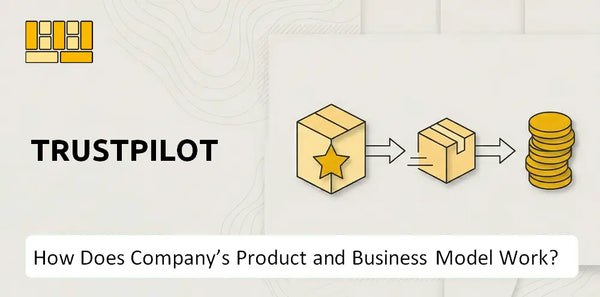
Trustpilot's review funnel drives retention: more reviews lift TrustScores, attracting businesses that pay for features and analytics; 2025 showed rising ARPU as enterprise uptake increased. See Trustpilot Business Model Canvas
WWhat Does Trustpilot Offer Customers?
Trustpilot sells a reviews platform and reputation-management suite that lets consumers read/write reviews for free and lets businesses collect, display, and analyze customer feedback to drive acquisition and reduce churn.
 Core product: open reviews platform and business reputation suite
The Trustpilot reviews platform combines a public, free-to-access consumer review community with a paid business product that includes verified profile pages, automated review solicitation, review display widgets, and analytics. In 2025 Trustpilot added AI-driven insights to map reviews to specific operational issues and prioritize remediation.
Who uses it: consumers and businesses
Millions of consumers use the free review site as a decision tool at point of purchase while merchants-from SMBs to enterprise retailers-subscribe to Trustpilot business plans for reputation management and customer experience analytics.
Value to customers: credibility, discovery, and operational insight
Consumers gain unbiased, searchable reviews that influence buying decisions; businesses gain higher organic click-through and lower customer acquisition cost by integrating reviews into SEO and marketing. Trustpilot reports clients saw average conversion lifts and measurable SEO gains after review integration.
Why it matters: trust signals and measurable ROI
As a Trustpilot product, the reviews platform serves as a trust signal that boosts visibility in search results and marketing collateral. In fiscal 2025 many clients cited improved conversion rates and reduced CAC after deploying Trustpilot review widgets and following AI-suggested fixes from the business dashboard.
Key features include verified profile pages, automated review solicitation (email/SMS/API), moderation and fraud detection, review widgets for websites, structured data to surface reviews in SERPs, and an enterprise dashboard with sentiment analytics and AI-driven friction-point detection; Trustpilot's business dashboard reports and subscription tiers drive the Trustpilot revenue model via recurring SaaS fees and add-on services.
For implementation developers, Trustpilot offers API integration and Shopify plugins to show reviews on product pages and marketing; marketers use widgets and structured data to improve SEO (Trustpilot vs Google Reviews for SEO impact is a common evaluation). See Leadership and Ownership of Trustpilot Company for related corporate context.
Trustpilot SWOT Analysis
- Complete SWOT Breakdown
- Fully Customizable
- Editable in Excel & Word
- Professional Formatting
- Investor-Ready Format

HHow Does Trustpilot's Product or Service Reach Users?
Trustpilot's product reaches users through a high-velocity digital distribution model: consumers find Trustpilot reviews via web and mobile search, while businesses integrate review collection into order flows using platform connectors and API-driven invitations. Onboarding is self-serve SaaS for SMBs and direct-sales for enterprise, enabling near-immediate review collection after transactions.

Operating flow: review capture to display
Transactions trigger automated invitation delivery (email/SMS) through integrations, consumers submit reviews on Trustpilot's web or mobile app, and reviews are published after automated and manual moderation. This loop feeds brand pages that rank high in organic search, driving more consumer traffic and review submissions.
Product delivery: integrations and self-serve SaaS
Trustpilot product is delivered via pre-built connectors for Shopify, Magento, WooCommerce and via the Trustpilot API for custom platforms, plus native web and mobile access for consumers. Businesses configure invitation timing and templates in the Trustpilot business dashboard to capture post-purchase feedback automatically.
Development: platform and moderation engine
Product development centers on backend services: scalable review ingestion, moderation algorithms, fraud detection, and analytics. Trustpilot maintains engineering teams for API, SDKs, and connectors; moderation mixes automated filters with human reviewers to enforce policy and GDPR compliance.
Channels: owned web, mobile, and partner platforms
Consumers access Trustpilot via organic search, direct visits, and the mobile app; businesses access via the self-serve portal and direct sales. Third-party integrations (ecommerce platforms, CRM, email providers) and SEO visibility act as primary distribution channels for both users and business customers.
Key assets and partnerships
Key assets include the review database, moderation systems, APIs, and analytics dashboard. Strategic partnerships with Shopify, Magento, and major email/SMS providers plus strong SEO presence sustain volume; enterprise clients get dedicated account management and SLAs.
What keeps it running day to day
Daily operations rely on automated invitation delivery, moderation throughput, and indexing for search. Metrics to watch: invitation send rate, conversion-to-review, remediation of flagged reviews, and subscription renewal-these drive the Trustpilot business model and recurring revenue.
Relevant metrics as of fiscal 2025: Trustpilot reported ~120 million reviews on the platform, business customers exceeded 500,000, and recurring revenue growth rate was reported at ~15% YoY (FY2025 filings). For integration guidance and platform impact, see Why Customers Choose Trustpilot Company
Trustpilot VRIO Analysis
- Complete VRIO Analysis
- No Research Needed – Save Hours of Work
- Built by Experts, Trusted by Consultants
- Instant Download, Ready to Use
- 100% Editable, Fully Customizable

HHow Does Trustpilot Earn Money from Usage?
Revenue flows from businesses subscribing to Trustpilot's paid plans and buying add-ons; demand converts to recurring ARR through tiered subscriptions, usage-based invitation volumes, and paid data/marketing features.
Subscription SaaS: Core Revenue Engine
The Trustpilot business model centers on a tiered SaaS subscription where most revenue comes from paid plans (Standard to Enterprise). This recurring model produced an $230,000,000+ ARR for the fiscal year ending 2025, making subscription fees the primary driver of Trustpilot reviews platform monetization.
Add-ons, API and Location Modules
Trustpilot generates additional income via paid modules for location-specific reviews, API access for custom integrations, and advanced marketing assets. These add-ons raise lifetime value as companies scale and seek deeper analytics and integrations.
Pricing Logic: Usage and Scale
Pricing scales with customer transaction volume and monthly review invitations; higher invitation volumes and premium features move customers into higher tiers. Trustpilot pricing for businesses ties fees to usage, so growth in merchant transactions directly lifts subscription revenue.
Retention and Upsell: Strongest Revenue Driver
Net contract retention in enterprise exceeded 100 percent in 2025, indicating upsell and expansion are the clearest revenue drivers. Enterprises add seats, invitations, and analytics modules, boosting ARR without proportionate new acquisition costs.
For a deeper operational and product view, see Product Growth of Trustpilot Company
Trustpilot Marketing Mix
- Complete Marketing Mix Analysis
- Effortlessly Communicate Your Business Strategy
- Investor-Ready Format
- 100% Editable and Customizable
- Clear and Structured Layout

WWhat Makes Customers Stay with Trustpilot's Model?
Trustpilot's model rests on network effects and technical switching costs that lock businesses into its reviews platform; strengths include reputation equity and Google integration, while risks stem from regulatory scrutiny, AI accuracy limits, and competitive review aggregators.

Why Trustpilot's Model Retains Customers
Strong network effects, indexed reputation equity, and search-engine integrations make Trustpilot central to marketing stacks; loss of integrations or AI credibility would weaken retention.
- Network effect: thousands of verified reviews create rising returns to scale for businesses that stay with Trustpilot
- Key dependency: reliance on Google Seller Ratings integration and continued API/search indexing
- Capability: AI-powered sentiment analysis and business dashboard analytics turn reviews into actionable BI
- Resilience assessment: overall resilient due to entrenched SEO value, but exposed to regulatory/legal and AI-moderation risks
Customer retention is driven by two related forces: the accumulation of reputation equity and technical switching costs. For a merchant, migrating off Trustpilot means abandoning a corpus of often tens of thousands of verified reviews and a TrustScore that search engines and ad systems have indexed over years; that loss can cut organic visibility and reduce Google Ads click-through rates within days.
Trustpilot's status as an official Google Review Partner directly feeds Trustpilot reviews into Google Seller Ratings; marketers report immediate measurable drops in ad performance and conversion when feed access is lost. In published cases, sellers have seen CPC increases and conversion declines in the low double digits after decoupling from third-party rating feeds.
By 2026, Trustpilot integrated AI sentiment analysis into its Trustpilot business model and product suite, shifting the platform from a badge-of-trust play to a business intelligence layer. The Trustpilot business dashboard now surfaces sentiment trends, churn-risk signals, and product-level CSAT (customer satisfaction) metrics that firms use to prioritize fixes-functions that increase switching costs because similar historical analytics are seldom portable.
Monetization strengthens stickiness. Trustpilot's revenue model combines subscription pricing tiers for businesses with transactional and add-on services; enterprise accounts pay for enhanced moderation, API access, and bespoke analytics. As of fiscal 2025, business subscription and services contributed the majority of recurring revenue, with enterprise customers accounting for a concentrated share of ARR (annual recurring revenue), reinforcing long-term contractual inertia.
Technical and procedural switching costs are significant: exported review data loses SEO context, historical TrustScores don't port to competitors, and integration work-Shopify plugins, API endpoints, ad feed mappings-creates weeks to months of engineering and marketing rework. Trustpilot pricing for businesses and its developer-facing Trustpilot API integration for developers make a migration project costly and operationally risky.
Trust and moderation add another retention layer. Trustpilot's verification and review moderation process explained: a mix of automated filters, AI classifiers, and human reviewers reduces fraudulent content and preserves platform credibility. Businesses value the provenance and public visibility of verified reviews; losing that provenance can weaken conversion narratives and social proof on product pages and in paid channels.
Platform fit into stacks is deep: marketers link Trustpilot into e – commerce (how to integrate Trustpilot with Shopify), CRM, and ad platforms; customer-success teams pull Trustpilot business dashboard features and analytics into daily workflows. The platform's role in SEO (Trustpilot vs Google Reviews for SEO impact) and ad performance magnifies the cost and risk of leaving.
Nonetheless, fragility exists. Regulatory pressure (GDPR and consumer protection enforcement), high-profile moderation errors, or demonstrated AI misclassification could erode trust. Competitors offering lower-cost moderation, superior fraud detection, or native integrations with major marketplaces could win marginal customers. Still, Trustpilot retains a structural advantage as the most recognized third-party validation tool globally, which supports retention among ecommerce businesses focused on conversion lift and reputation management.
For further reading on customer growth dynamics and acquisition economics, see Customer Acquisition of Trustpilot Company
Trustpilot Ansoff Matrix
- Complete ANSOFF Matrix
- Structured for Consultants, Students, and Founders
- 100% Editable in Microsoft Word & Excel
- Instant Digital Download – Use Immediately
- Compatible with Mac & PC – Fully Unlocked

Related Blogs
- What Do the Mission, Vision, and Values of Trustpilot Company Say About Its Brand?
- How Did Trustpilot Company Become the Brand It Is Today?
- Who Runs Trustpilot Company and Shapes Its Direction?
- How Does Trustpilot Company Attract, Convert, and Keep Customers?
- How Can Trustpilot Company Grow Through Products and Customers?
- Who Are the Core Customers of Trustpilot Company?
- Why Do Customers Choose Trustpilot Company Over Competitors?
Frequently Asked Questions
Trustpilot offers a free consumer reviews platform and a paid business reputation suite. Consumers can read and write reviews, while businesses use verified profile pages, automated review collection, display widgets, analytics, and AI-driven insights to improve credibility, discoverability, and customer experience.
Disclaimer
All information, articles, and product details provided on this website are for general informational and educational purposes only. We do not claim any ownership over, nor do we intend to infringe upon, any trademarks, copyrights, logos, brand names, or other intellectual property mentioned or depicted on this site. Such intellectual property remains the property of its respective owners, and any references here are made solely for identification or informational purposes, without implying any affiliation, endorsement, or partnership.
We make no representations or warranties, express or implied, regarding the accuracy, completeness, or suitability of any content or products presented. Nothing on this website should be construed as legal, tax, investment, financial, medical, or other professional advice. In addition, no part of this site - including articles or product references - constitutes a solicitation, recommendation, endorsement, advertisement, or offer to buy or sell any securities, franchises, or other financial instruments, particularly in jurisdictions where such activity would be unlawful.
All content is of a general nature and may not address the specific circumstances of any individual or entity. It is not a substitute for professional advice or services. Any actions you take based on the information provided here are strictly at your own risk. You accept full responsibility for any decisions or outcomes arising from your use of this website and agree to release us from any liability in connection with your use of, or reliance upon, the content or products found herein.